 EN
 Romana
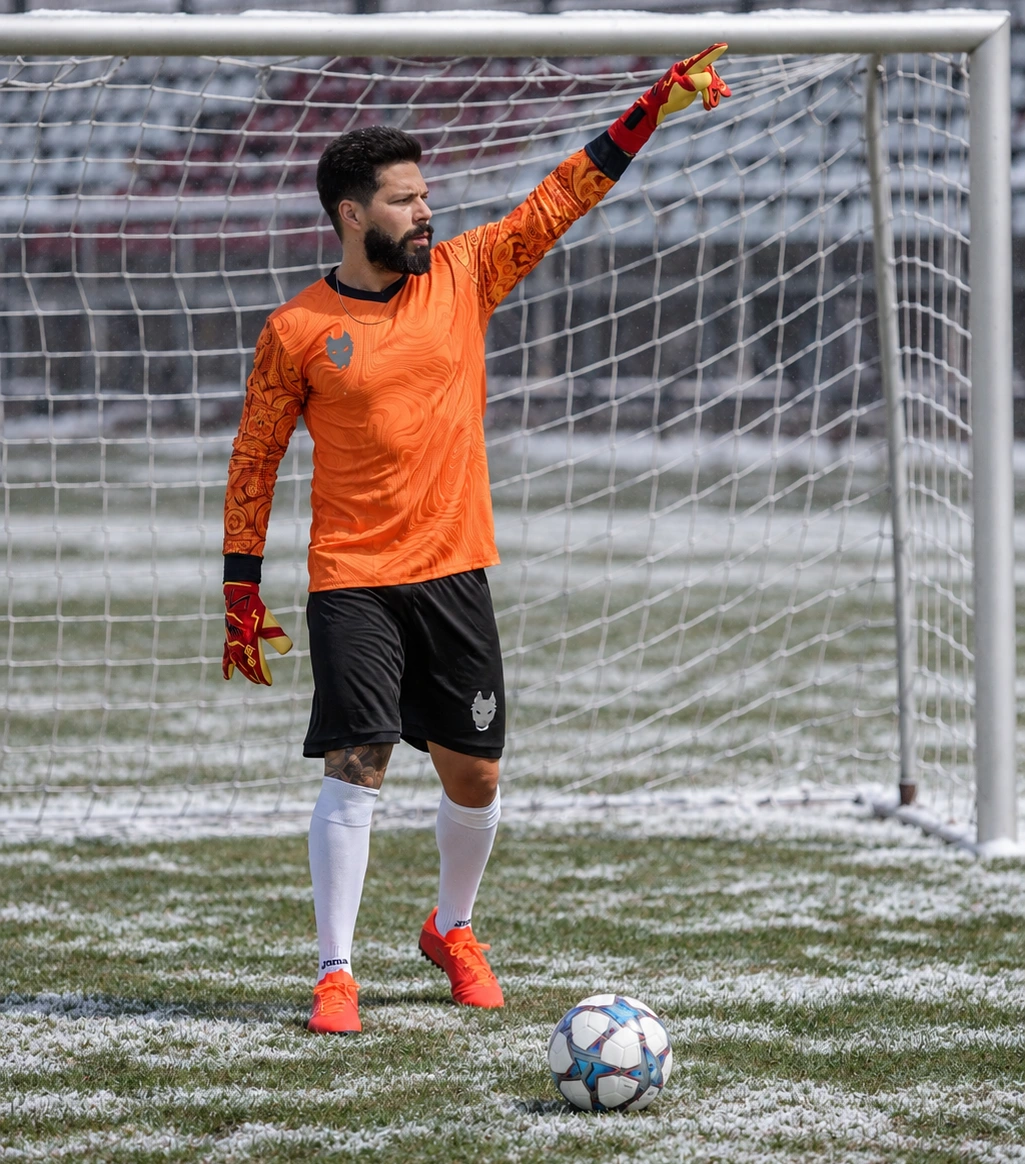
Winter is the season when goalkeeper gloves get ruined most easily, and most of the time it is not the matches that do it, but what happens to the gloves before and after them. The latex on the palm is sensitive to temperature: in the cold it stiffens and loses grip, and care mistakes that go unnoticed in summer cost you quickly in winter.
The good news: you don't need a special "winter pair" to play well in the cold. You need a few right habits. Below are the Lupos GK recommendations for the whole cold season, from the dressing room to drying your gloves after the match.
What cold does to latex
Latex grips best when it is soft and slightly damp. As the temperature drops, the foam stiffens: the palm gets harder, you feel the ball less, and grip drops noticeably. On artificial turf the effect is even stronger, because the cold, abrasive surface hardens and wears the latex faster.
Cold doesn't only affect the glove, it affects your hands too. Stiff fingers react more slowly and close around the ball later, and that matters just as much as the latex.
Before the match: keep your gloves warm
The most common winter mistake: leaving your glove bag in the car boot overnight. Latex that has spent hours below freezing goes onto the pitch already stiff and needs a long time to recover.
- Keep your gloves indoors or in the dressing room, at room temperature, until the warm-up.
- Between the warm-up and kick-off, keep them under your jacket or in the dressing room, not on the bench.
- Warm up your hands as well: rub them, clench your fists, take a few easy catches before the hard shots.
Should you wet the latex in the cold? It depends on the temperature
In summer, the standard advice is to lightly dampen the palms with lukewarm water before playing: damp latex grips better and wears more slowly. In winter, the same advice can do more harm than good. Below 0°C, the water on the palm freezes: a film of ice forms and becomes slippery, and water that has soaked into the foam can freeze in the pores and make the already stiff latex more brittle.
The Lupos recommendation, by temperature:
Above 5°C
Wet the latex as usual with lukewarm water, before the match and at half-time. The latex behaves almost as it does the rest of the year.
Between 0 and 5°C
Dampen very lightly, right before you walk onto the pitch, not ten minutes earlier. Keep the gloves warm until the last moment.
Below 0°C
No added water. Keep the gloves warm until kick-off and rely on the natural moisture of your hands on the pitch. If the latex picks up snow or frost, wipe it off; don't wet it.
These thresholds are a practical recommendation, not a technical standard. Wind, humidity and how often you touch the ball matter too: in a match where you rarely see the ball, your gloves cool down more than in a busy one.
During the match
- Keep a towel by the goal. On a wet or snowy pitch, a towel lets you quickly clear mud, water or snow from the palm. Latex that is soaked or covered in mud loses its grip.
- Keep your hands moving between phases of play. Clench your fists, clap your hands (without rubbing latex against latex), keep your fingers active.
- At half-time, your gloves go to the dressing room with you. Don't leave them on the post or in the net.
After the match: this is where most gloves get ruined
In winter, it's tempting to throw your wet gloves into the bag and rush home. That is exactly what shortens their life.
- Don't leave them wet in your bag or in a cold car. Wet gloves shut inside a bag for hours at sub-zero temperatures can freeze, and the latex suffers. On top of that, a damp, closed bag encourages mould and odour.
- Don't press them palm to palm while they're wet. Wet latex sticks to itself and can tear when you pull the palms apart.
- Wash them as soon as possible with lukewarm (not hot) water, by hand, without brushes or abrasive sponges. You'll find the full washing guide in How to wash and care for goalkeeper gloves.
Drying: rule number one is "never on the radiator"
In winter, the radiator looks like the obvious solution. It is the surest way to destroy a pair of gloves. Direct heat draws the moisture out of the latex, over-dries it, makes it brittle and can deform the glove. The same goes for hair dryers, fan heaters, fireplaces and tumble dryers.
How to dry them properly:
- Gently remove excess water by pressing the glove into a towel, without twisting it.
- Let it dry at room temperature, away from heat sources, with the opening facing down so the water can drain.
- Be patient: natural drying usually takes between 12 and 24 hours.
- Don't leave them to dry out completely for days. Fully dried latex turns stiff, so dampen it lightly before the next use.
Storage between training sessions
Clean, dry gloves should be stored in a ventilated place at room temperature: not in a closed kit bag, not in the car boot and not on a freezing balcony. A mesh bag or a cover that lets air circulate is ideal. Don't fold them or crush them under other kit, so the latex doesn't crease.
Do you need a separate pair for winter?
It isn't essential. More important than a "winter" model is having at least two pairs and rotating them: one for training, especially on artificial turf and frozen ground, and one for matches. That way your match pair stays in good shape all season, while your training pair takes the heavy winter wear. More details in Goalkeeper gloves for match vs training.
If you often play in rain and sleet, the type of latex matters too. The differences are explained in Soft or hard latex: how latex affects performance in the rain. And if winter moves you onto artificial pitches, also read Goalkeeper gear for synthetic vs. natural grass.
Look after your gloves in winter and they'll look after you in spring. If your pair didn't survive last season, you'll find all our models in the Lupos goalkeeper gloves category.