 EN
EN  Romana
A pair of quality German latex goalkeeper gloves can last between 15 and 40 matches. Or they can last 5, if you throw them wet and dirty into your bag after every training session.
The difference isn't in the glove — it's in what you do with it after the final whistle.
The latex on the palm is a living material: porous, hygroscopic, sensitive to temperature and chemicals. Treat it correctly and it stays soft and grippy. Don't — and it turns stiff, dry and slippery within a few weeks. At that point, not even the most expensive gloves in the world will help you.
This guide covers everything you need to know: from the first wash before use, to your post-match routine, to long-term storage. No unnecessary complications — just concrete steps that work.
Before first use: activating the latex
New gloves come with the latex "asleep". At the factory, the material is treated with preservatives that maintain its properties during storage and transport. These substances form a thin film on the palm surface that reduces initial grip.
That's why, on your first save with new gloves, the latex often doesn't grip the way you'd expect. It's not a defect — it's latex that hasn't been activated.
What to do:
- 24 hours before your first match or training session, wash the gloves following the steps below (lukewarm water, no harsh soap)
- Let them dry naturally, in the shade
- Before the game, dampen them lightly again
After the first wash, the latex opens up, the pores activate, and the grip reaches its true capacity. Some goalkeepers do two activation washes before the first match — it doesn't hurt, but one is usually enough.
How to wash goalkeeper gloves: 5 steps
A proper wash takes no more than 5 minutes. Do it after every use — or at least after every match and after training on a dirty pitch.
Step 1 — Immediate rinse
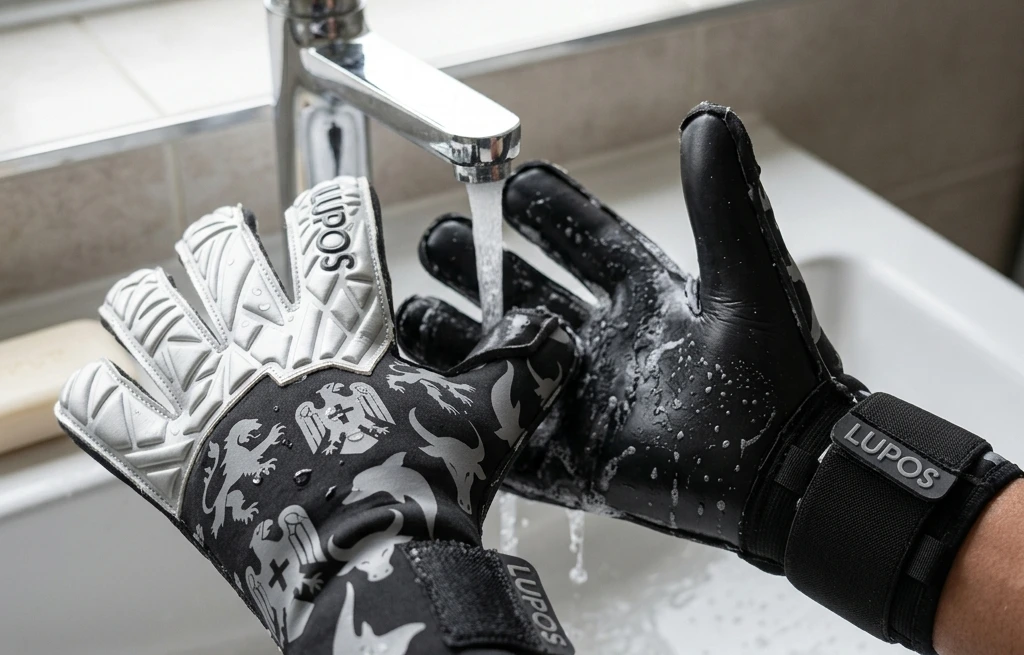
Right after you finish (ideally in the locker room, or at home within the first hour), rinse the gloves under lukewarm running water. The goal is to remove mud, dust and sweat from the surface before they dry and settle into the pores of the latex.
Hold the glove under the stream and gently rub the palm with the fingers of your other hand. Don't scrub aggressively — the latex is soft and can be damaged mechanically.
Step 2 — Soak
Fill a basin or the sink with lukewarm water — maximum 30°C. Not hot water. Submerge both gloves completely and leave them for 2–3 minutes.
Step 3 — Washing
Put the glove on one hand and, with the other, gently rub the latex palm using soft circular motions. Focus on the highest-contact areas: the centre of the palm, the base of the fingers, and the grip zone between thumb and index finger.
What soap to use:
- Ideal: plain water, no soap. For most routine washes, lukewarm water is enough
- If the gloves are very dirty: a very mild liquid soap, free of dyes and phosphates. One small drop on each palm
- DO NOT use: dishwashing detergent, shampoo, laundry soap, bleach, or any product with aggressive chemical agents. These break down the molecular structure of the latex and permanently destroy its grip
Step 4 — Final rinse
Rinse the gloves under running water until the water runs clear and no trace of soap remains. Soap residue on the latex forms a film that reduces grip — the exact opposite of what you want.
Step 5 — Removing excess water
Gently squeeze the glove into a fist to push out the water, then wrap it in a clean towel and press lightly.
Don't wring it out by twisting. Twisting deforms the seams, stretches the material and can tear the glove's internal structure. Squeeze — don't twist.
How to dry the gloves properly
Improper drying ruins more gloves than use on the pitch does. Here's the simple rule:
Air dry, in the shade, with the palms apart.
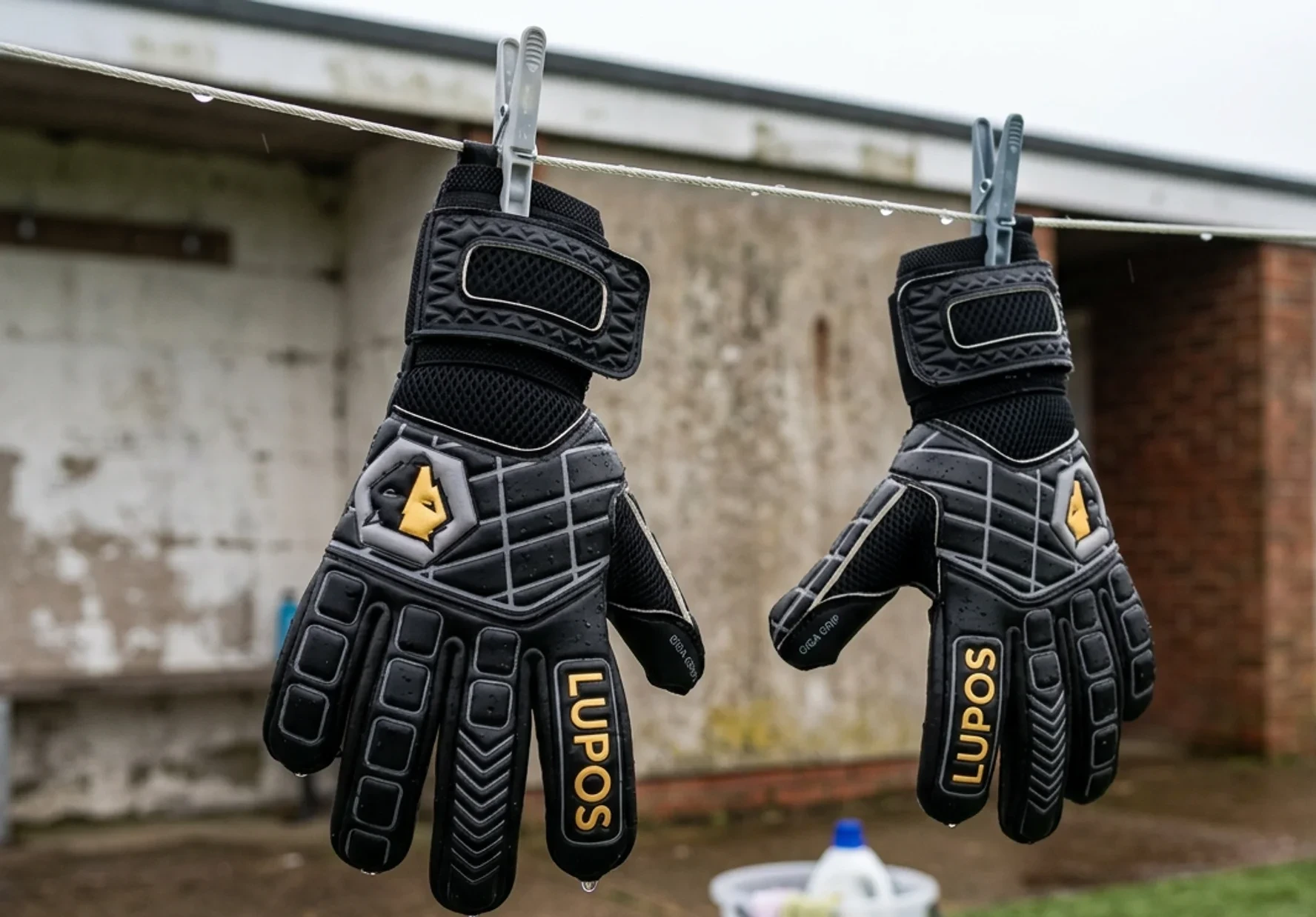
Hang the gloves on a hanger, a shower rail or a hook, fingers down. Make sure the palms aren't touching each other — if wet latex sticks palm to palm, material will tear away when you separate them.
Complete drying takes between 12 and 24 hours, depending on the humidity in the room.
5 drying methods that destroy latex
| Method | Why it destroys the latex |
|---|---|
| Radiator / heater | Excessive heat evaporates the natural moisture from the latex, making it stiff and brittle |
| Hair dryer | Same effect, concentrated and more aggressive |
| Direct sunlight | UV radiation degrades the molecular structure of the latex — it becomes crumbly |
| Tumble dryer | The combination of heat + mechanical tumbling completely destroys the glove |
| Leaving them in the bag (wet) | Bacteria and mould develop within hours, causing odour and accelerated degradation |
Of all of these, leaving them in the bag is the most common mistake and the most damaging in the long run. A goalkeeper who does this after every training session can cut the lifespan of the gloves by 50% or more.
How to store the gloves
Between uses (during the season)
Once the gloves have dried completely (minimum 24 hours):
- Keep them in a cool, dry place, away from direct light
- The palms must not touch. Latex is adhesive by nature — if two latex surfaces stay stuck together, particles of material tear away when you separate them. Put a sheet of paper or thin card between the palms if you store them stacked
- Don't leave them somewhere with extreme temperatures (a car boot in summer, a balcony in winter)
Long-term storage (the off-season break)
- Wash them one last time and dry them completely
- Pack them with paper between the palms
- Store them in a cool, dry place
Don't leave them for months on end in a bag or in a cupboard without ventilation. Latex needs a minimum of air circulation — otherwise it dries out excessively and loses elasticity.
Pre-match preparation: dampening the latex
Latex performs best when it's slightly damp. It's a material designed to be used with water — that's why professional goalkeepers dampen their gloves before every match and during breaks in play.
10–15 minutes before the game:
- Dampen the palms under running water or with a water bottle
- Rub the palms together lightly to distribute the water evenly
- Squeeze out the excess — you want moisture, not gloves dripping water
During the match, dampen them again at every opportunity: stoppages, corners, any dead moment. Most professional goalkeepers keep a water bottle by the goal for exactly this.
In the rain, latex performs excellently — rain naturally activates the grip. The only problem is the slippery ground when diving, not the grip of the palm.
In the cold, latex becomes stiffer. Dampening matters even more in winter. Some goalkeepers use slightly warm water for activation.
Grip spray: when and how to use it
Grip spray is an auxiliary product that adds a layer of extra tack to the latex surface. It doesn't replace washing, it doesn't repair destroyed latex, and it doesn't turn a cheap glove into a professional one — but it can improve the grip of a well-maintained glove, especially in difficult conditions.
When it makes sense:
- Dry, dusty pitches, where latex naturally loses grip
- Gloves with a few matches on them, where the grip has started to drop off slightly
- Mixed conditions (alternating rain and sun) where the latex surface behaves unpredictably
How to apply it (LUPOS Hyper Grip, 100 ml):
- Shake the container well
- Apply 2–3 sprays to each palm
- Rub the palms together for even distribution
- Wait a few minutes before playing
- After use, wash the gloves following the routine above
When it doesn't help: if the latex is already destroyed (dry, crumbly, with no porosity), the spray won't bring it back to life. In that case, the gloves need replacing.
The 7 mistakes that destroy gloves fastest
1. Leaving them wet in the bag after training. The most common and most damaging habit. Bacteria and mould set in within hours.
2. Washing them with dishwashing detergent. Detergent is formulated to break down grease — which is exactly what it does to the structure of the latex. A single wash can permanently reduce grip.
3. Drying them on the radiator. The latex loses its natural moisture, turns stiff and cracks. Irreversible.
4. Using them on concrete or asphalt. Abrasive surfaces destroy latex mechanically. If you're training on concrete, use training gloves, not your match ones.
5. Storing them with the palms stuck together. Latex tears away when separated. Always put something between the palms.
6. Using them dry. Latex without moisture grips more weakly and wears out faster through dry friction. Always dampen them before playing.
7. Washing them rarely, but aggressively. A light rinse after every use beats an intensive wash once a month. Gentle frequency beats occasional intensity.